
 Redaction Tools
Redactable on the 54-name page: the best result yet, and too much removed
Redactable removed 53 of 54 copies of a planted name, including every rotated and stacked copy. Its wizard also blacked out the byline, URLs and dates, so it fails our usability bar.
5 min read
Mykola Melnyk
Maintainer, Redaction Tools
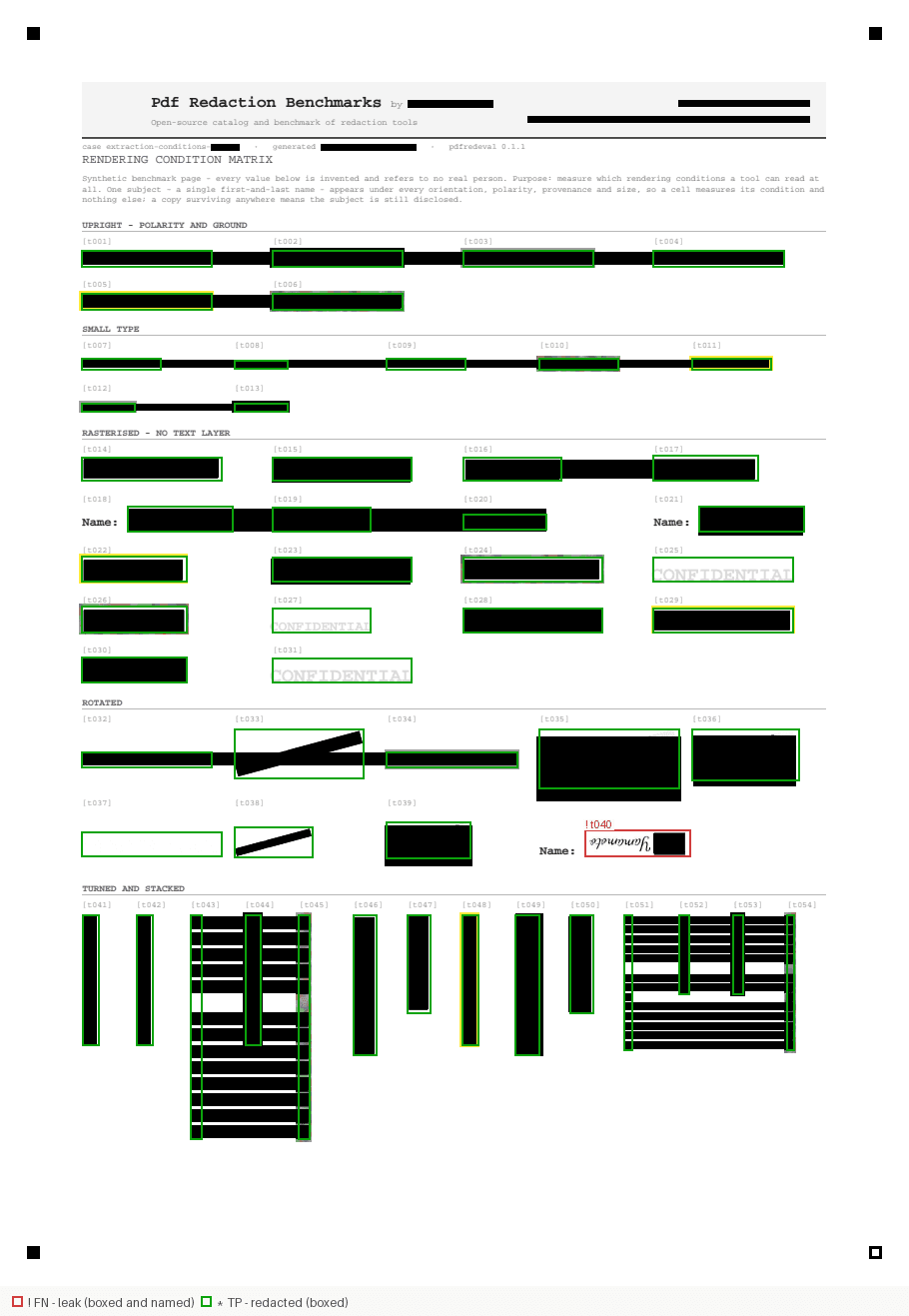
TL;DR: We ran Redactable through the extraction-conditions page, the PDF that carries one invented name 54 times in 54 different forms. It removed 53 of 54. That is the lowest leak rate on the leaderboard so far, and it includes all four letter-by-letter stacks that defeated every other tool running its own detection. It also removed things nobody asked it to: the byline, both header URLs, the case number and the date. Only 81% of the page's harmless text is still selectable, which fails our 90% usability bar.
If you haven't read the original write-up, it explains how the page is built and how a leak is decided. This post only covers what is new.
What Redactable is
Redactable is a cloud service built for redaction alone, not a PDF editor with a redaction button. You upload a document, and its Auto wizard lists suggested redactions by category (person and company names, credentials and so on). You tick what applies and it removes the content. It can also issue a redaction certificate that records what was removed.
It runs in the cloud only, so documents leave your machine. Pricing is by documents per month, with a free tier for evaluation. The plans and their sources are in the catalog.
The run
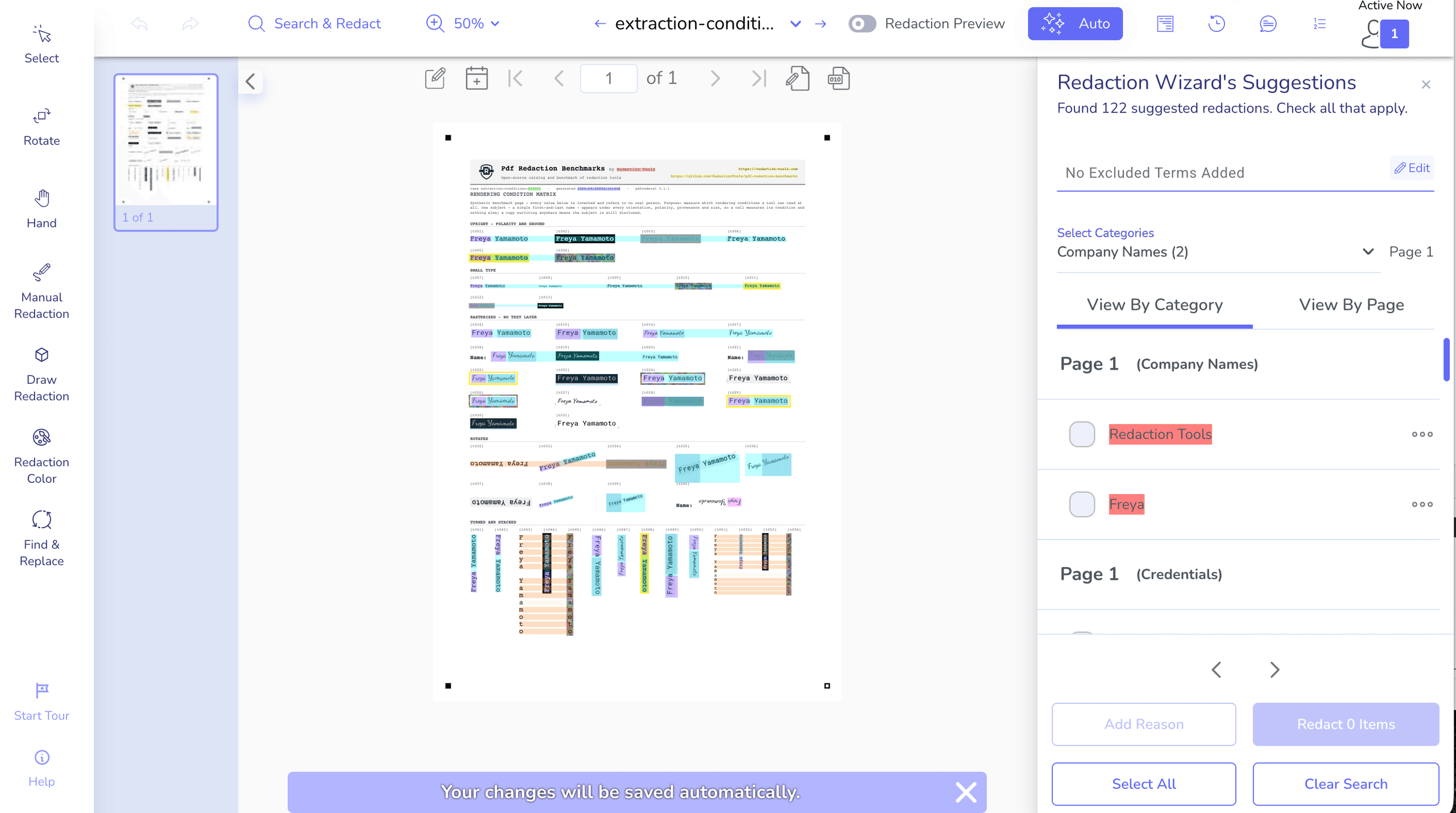
We uploaded extraction-conditions-1.pdf through the web app, ran the Auto wizard with
default settings and applied its suggestions. The wizard reported 122 suggested
redactions on a page that contains one name.
We scored the PDF it returned on our server, the same way as every other run:
| Where the name was | Removed | Note |
|---|---|---|
| Text layer (real text) | 27/27 | upright, small, rotated, vertical stacks |
| Image only (no text layer) | 26/27 | scans, handwriting, inverse, watermarked |
| Total | 53/54 | leak rate 0.019, 95% interval [0.003, 0.098] |
The full run has the output PDF, so you can check all of this yourself.
What it got right
Vertical stacks
Four names on the page are stacked one letter per line. They are real, selectable text, but
a parser returns them one character at a time, so a name detector never sees Freya Yamamoto.
PDF Redaction, AI-Redact, SafeRedact and KeptPDF, which all rely on their own detection,
removed none of the four. Blinded removed all four, but only because it was told what to
search for.
Redactable removed all four on its own detection. So it rebuilds words from where the letters sit on the page, not only from the order the parser outputs them in.
Rotated and scanned text
It removed 18 of the 19 rotated and skewed names, and every name in the turned-and-stacked band. The one rotated name it missed is the leak below. AI-Redact and SafeRedact removed none of the 19.
Names behind a watermark
Three cells carry the name under a light "CONFIDENTIAL" watermark, with no text layer. This was PDF Redaction's weakest condition: it missed all three. Redactable removed the name in all three without drawing a box at all. The watermark is still there, and the name is gone.
Removal, not covering
The name appears nowhere in the output's text layer. The page is still an A4 PDF with real,
selectable text, not a flattened image. The metadata contains only Producer: Redacted by Redactable.
The one leak
t040 is a form line, Name:, with the name handwritten in cursive and upside down, as on a
form that went through the scanner the wrong way round. Redactable drew a box over the
"Freya" end and left "Yamamoto" readable:
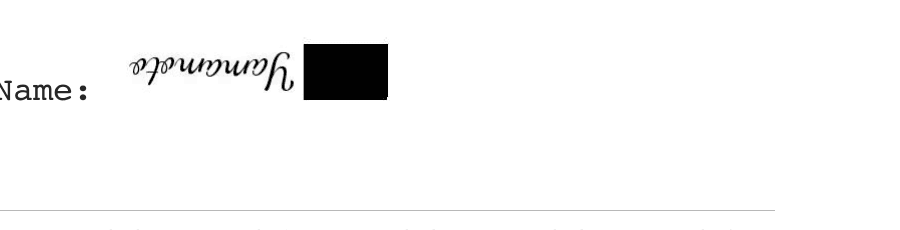
PDF Redaction leaked the same cell. A half-redacted name is still a leak, and a surname on its own is often enough to identify someone.
What it removed that it shouldn't have

Applying the wizard's suggestions also removed:
- the byline "Redaction Tools", which the wizard listed as a company name;
- both URLs in the header;
- the case number at the end of
extraction-conditions-1; - the generated timestamp.
None of these is personal data about Freya Yamamoto. Together they bring text retention to 0.807: about a fifth of the page's harmless text can no longer be selected. Our usability gate is 0.9, so the run fails it.
On this page that cost is small. On a contract or a court bundle, blacking out every company name, date and URL can make the document useless to whoever receives it. The alternative is to review 122 suggestions by hand. That is the trade-off of a wizard tuned to catch everything: you trade leaks for review time.
The output has one more oddity. In cell t037, the name was printed upside down in light grey
as real text. The output keeps a near-white, scrambled remnant of it, upright, and the text
layer reads Frmmammm Yyyoto. Our checker does not count that as the name, and we agree it
cannot be read as one. But it suggests Redactable rewrote the characters in that cell rather
than deleting them, and a remnant in the text layer is worth knowing about.
Where it sits
| Tool | Names removed | Leak rate, 95% interval | Text retention |
|---|---|---|---|
| Redactable | 53/54 | 0.02 [0.00, 0.10] | 0.807 |
| Blinded | 51/54 | 0.06 [0.02, 0.15] | 0.876 |
| PDF Redaction | 42/54 | 0.22 [0.13, 0.35] | 0.932 |
| AI-Redact | 30/54 | 0.44 [0.32, 0.58] | 0.951 |
| KeptPDF | 19/54 | 0.65 [0.51, 0.76] | 0.010 |
| SafeRedact | 14/54 | 0.74 [0.61, 0.84] | 0.000 |
The figures are from the live leaderboard, dataset revision v0.1.1. Redactable's interval overlaps Blinded's, so this page alone cannot say which of the two is ahead. Both fail the retention gate: so far, the two lowest leak rates both come with more than a tenth of the page's harmless text removed.
Disclosure: Redaction Tools is run by StabRise, which also makes PDF Redaction. The About page explains how we handle that. Redactable's run was scored by the same server, with the same checker, as ours.
Caveats
- One page, one run, one category. Every probe is a person's name, so this measures reading, not how well Redactable picks categories. A wizard that suggests 122 redactions for one name would likely look different on a page with many kinds of data.
- Settings. We used the Auto wizard with defaults and applied its suggestions. Redactable supports excluded terms and category selection. With the byline excluded, retention would be higher, and we have not measured whether the leak count would change.
- Simulated handwriting. The handwriting on the page is drawn from fonts, which makes it tidier than real handwriting.
Redactable can submit its own runs, for example with tuned settings. We rescore every one, and an editor reviews it before it is listed.
Comments
Sign in to join the discussion.